Date: 20 August 1097.
Place: the Taurus mountains, near present-day Konya and Kayseri, in central Turkey.
A famous European duke who very soon would become the first King of Jerusalem (de facto, if not quite de jure), one of the supreme commanders of the First Crusade, is lying flat on the ground, bleeding heavily from his back, with a four-hundred-and-fifty-kilo beast reared up over him about to finish him off. It all looks done. And yet that day, against every odd, the duke beats death to the punch and gets out alive… But the real, accidental protagonist of this story, dear readers, is not our duke, at least not entirely. Nor the bear that tried to kill him. The real hero is a man wearing a stained apron and holding a barber’s blade — a man we shall fictionally call Wim van Amsterdam, since we don’t know his real name…
Let me tell you the wild business of that distant day.
Just picture for a moment the noble Godfrey of Bouillon, Duke of Brabant and Lower Lorraine, that very same enormously strong giant Belgian who, on a wager with two Arab emirs, would prove capable of decapitating two adult camels with a single stroke of the sabre, and who two years later would become king, lying in the dust of a rocky hollow on Mount Erciyes. The duke is alone, badly wounded, shieldless, his spear snapped in two, his mail coat shredded, and an enormous brown bear reared up on its hind legs growling and advancing with the very obvious intention of tearing him to pieces.
And now, if you’ll follow me, very gently we’re going to take a small step back. Because the story is real, and to understand it properly it has to be told from the start.
Konya, Turkey, 20 August 1097: boredom is the mother of all mischief
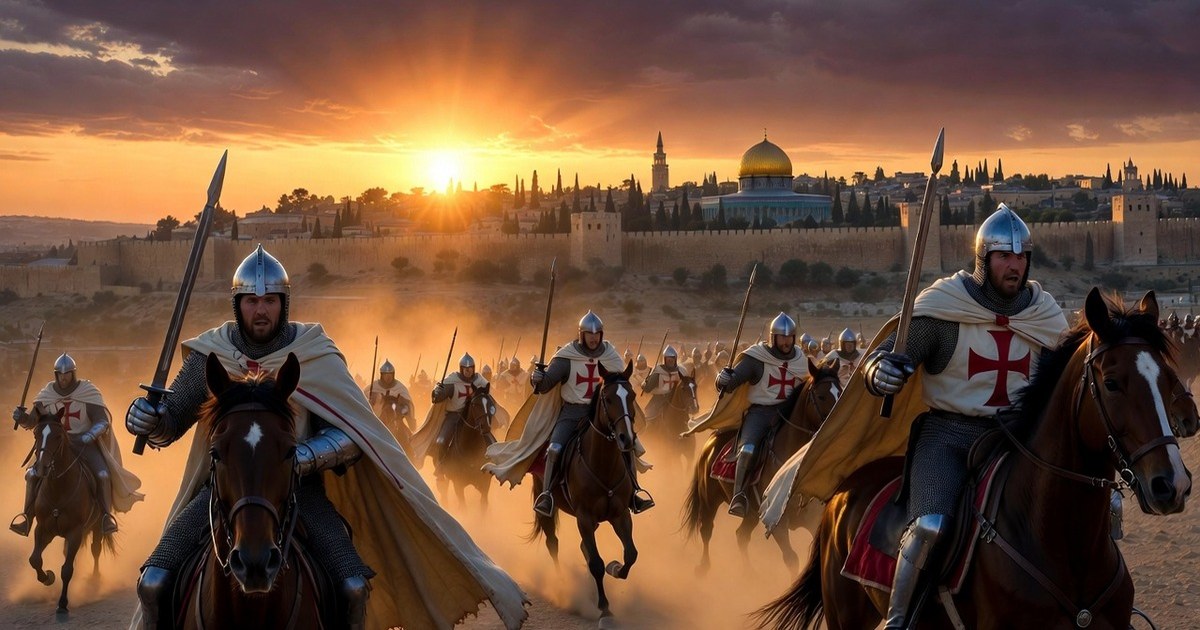
The great Crusader army that has come from Europe to retake Jerusalem has been camped for weeks on the outskirts of ancient Iconium, today’s Konya, sweating and cursing under a relentless Anatolian sun that splits stones. The Crusaders have just won their first great battle at Dorylaeum, the skin still burns on their scars, but there in Konya, marooned in the height of the Anatolian summer, the leaders, the great lords of the Christian army, are bored stiff. And we all know that when a medieval nobleman got bored, the same thing always happened: he went hunting.
Someone — by all accounts an Armenian guide far too keen to please his new European masters — has let slip that those nearby mountains are home to bears, wild boar, deer, pheasants, partridges, quail and wild turkeys. And then he adds the final, fatal detail: “And there is one bear, a giant, devilish beast that has already killed dozens of people, and whose hide nobody has yet been able to take.” That’s enough. The magic words that fire up the nobles have been spoken: hunt, giant bear, devilish beast, and above all, “the bear’s hide”. That proverbial trophy which, among European nobility, is worth more than any saint’s relic.
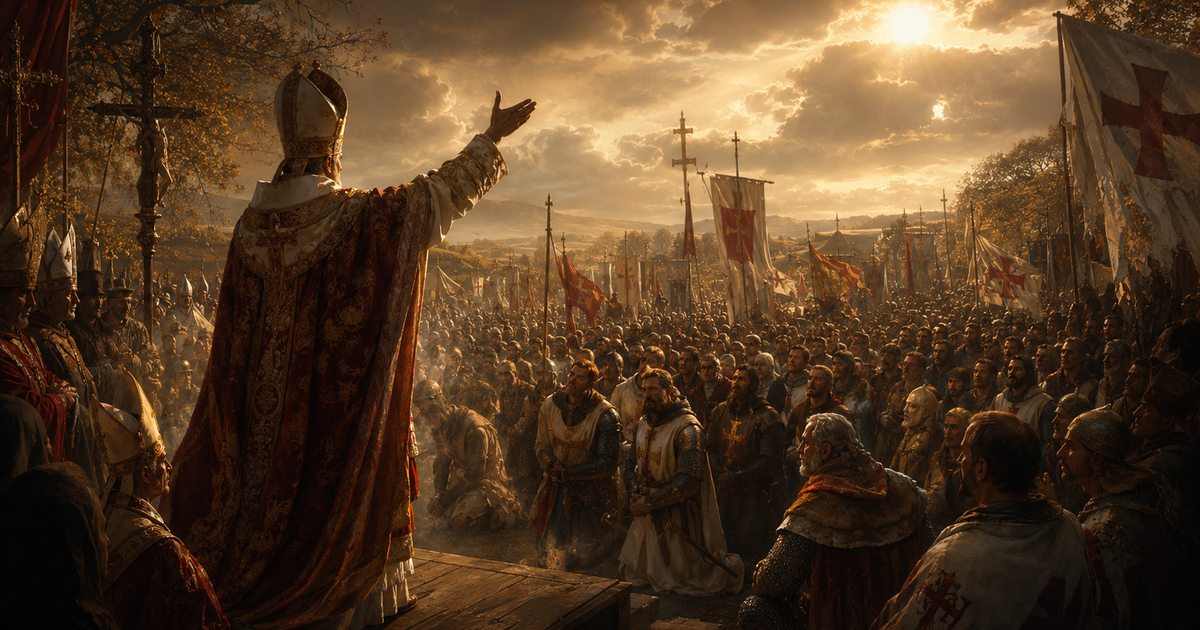
So a monumental hunt is organised: a small army of hunters, squires, soldiers, servants and a good thirty large hunting dogs sets off from Konya at dawn that same 20th of August, heading for the Taurus range. At the head of the column rides Godfrey with his brothers, Baldwin and Eustace of Boulogne, followed by Count Hugh of Vermandois, younger brother of the King of France, the old Provençal count Raymond of Saint Gilles, and the younger Counts Robert of Normandy, Robert of Flanders and Stephen of Blois, together with the Italian Prince Bohemond of Taranto, his nephew Tancred, and a hearty band of aristocrats eager to measure their manhood against the claws of that hairy Satan.
The Grizzly of the Taurus
By mid-afternoon, the dogs finally find him. The ursine Beelzebub is dozing peacefully in the shade of some leafy trees, digesting a generous lunch of honey and woodland berries. When the twenty-nine Crusader hounds close in around him barking like things possessed, the animal stands up. And it is at that moment that the Flemish, French, Italian and German hunters — men who have seen bears all their lives in the forests of central Europe — go slack-jawed. “This brute must stand two and a half metres tall and weigh at least four hundred and fifty kilos, my lord,” a frightened servant murmurs to Godfrey. And he isn’t exaggerating.
Technically it is a European brown bear, an Ursus arctos arctos, but in size, mass, fury and reach it looks more like a Grizzly of the North American Rockies. A prehistoric creature. A furry war machine.

The bear, surrounded, first tries a feeble defence. Then he tries to flee, but seeing he’s not allowed to escape, he charges at men and hounds. With two clean, almost surgical swipes, he kills two of the dogs and tears an opening through the pack, breaking into a desperate run northward, towards the higher slopes, looking for his lair, no doubt. Everyone takes off after him.
The deadly duel between man and beast…
Godfrey, who is an expert horseman and one of the finest hunters in the forests of Lower Lorraine, reads that unfamiliar terrain as if it were his own, reads the animal’s movement, and takes a shortcut the others miss. Within minutes he plants himself, alone, in a small hollow ringed by steep slopes where the bear has taken refuge, cornered before the dark mouth of a cave; his lair.
The duke rides up brandishing his long javelin, sweating bullets — we are in the height of August and, even though he’s travelling light, all he has on is a tunic and a metal mail coat over his chest, a long shield bearing the blazon of his house, and a spear. And no protection on his back. Bear that detail well in mind. That bare back is all that’s going to matter in the next thirty seconds. Godfrey starts pricking the beast with the tip of his spear, harassing it, waiting for the others to arrive so they can finish it off together. The bear roars, rises onto its hind legs and advances on Godfrey’s horse, slashing the air with its claws. Godfrey’s horse, an enormous heavy Friesian war-charger as black as night, an animal supposedly trained not to panic in battle, this time panics. It bolts forward and unhorses the duke. Godfrey falls. The shield slips from his hand and rolls away.

The duke gets back up faster than a cat — he’s a warrior, not a frightened novice — and goes back to pricking the bear with his spear, shouting at the top of his lungs so that the others might hear him. But the animal, with a single swipe of its paw, snaps the spear in two. The shaft flies away. Godfrey draws his dagger.
A dagger against four hundred and fifty kilos of rage, muscle and fangs? We can already imagine how this is going to end.
The Duke of Lorraine backs off, trips. And it’s that trip that condemns him to almost certain death. The bear takes its chance and lands a frontal swipe straight onto the mail coat on his chest and shreds it. The blow is so brutal it knocks the air out of his lungs and spins him a full hundred and eighty degrees like a rag doll, leaving him with his back to the animal. And that’s when the second terrible swipe lands, on the unprotected back — no armour, no nothing, only the cloth of a linen tunic and human skin. The hairy demon’s claws open up a long, deep gash on his back, which within seconds is pumping blood. Godfrey drops to his knees. The bear closes in to finish the job with its proverbial deadly “embrace”.

And just then, from the edge of the wood, in come a good thirty arrows whistling like a swarm of bees. Bows, crossbows. The bear, struck and riddled from every side, lets out one last terrible roar and crashes over backward, dead.

The hunters come running and immediately load the half-conscious duke onto an improvised stretcher. And it is here, dear readers, that the first part of this story ends and the part I really want to tell you begins.
Enter Doctor Wim van Amsterdam
They take Godfrey down as fast as they can, laid out on that makeshift stretcher of wood, rope and leather, all the way to the Crusader camp at Konya, fainted, half dead, and bleeding rivers of blood all along the road. Once at Konya he is delivered into the skilled hands of a certain Wim van Amsterdam, the official physician of the Flemish contingent.
Now then. Reading the word “physician” today, one pictures a professional with a university degree, a white coat and a stethoscope. Nothing could be further from the truth. In the year 1097, and especially within an army on full military campaign, the physician was also barber, surgeon, and very often dentist and bonesetter as well. They were trades that piled up on a single person because they all shared the same tools — blades and razors — and because barbers tended to encounter every kind of ailment in their work and built up enormous empirical experience. Because in the Middle Ages, and likewise in the centuries that followed, the man who shaved you in the morning, pulled a tooth at noon, set a fracture in the afternoon and stitched up an arrow wound at night, was exactly the same person. One thing or the other, depending on what the day or the moment called for.
And no, I am not making this up. For centuries, barber-surgeons were the real, and indeed the only, physicians of the battlefield. In England, for example, they had their own guild until 1745. And in some European villages, well into the nineteenth century, you went in for a shave and came out with one tooth fewer.
Well then, Mr Wim van Amsterdam — that character who in my medieval novels turns up with his stained apron and his razor in hand right when he’s most needed — turns out to be the real protagonist of that afternoon of the twentieth of August.
When they hand him the duke’s nearly lifeless body, Doctor Wim deploys a medical protocol astonishing for its time…
First: the cleansing
He cuts away the torn cloth of Godfrey’s tunic and washes the wound with plenty of vinegar. Vinegar — that is, acetic acid — a powerful natural antiseptic that any modern faculty of medicine would recognise as valid without batting an eye.
Second: the ointment
He applies over the gash on the back an ointment of his own invention, made of three ingredients: honey, powdered willow-bark, and pine resin.

Third: the bandages
And he finishes the whole job off with previously boiled linen bandages. Boiled. That is, sterilised.
Mr Wim van Amsterdam, knowing nothing about germs, with no microscope, no knowledge of bacteriology whatsoever, was doing all three things right: antiseptic, topical antibiotic, sterile material. By pure empiricism, by a tradition handed down from master to apprentice, by having seen and tested for himself in the field what worked and what didn’t on thousands of earlier wounds.
Godfrey of Bouillon recovers, and within less than two weeks he is walking again. In fact, on the thirty-first of August 1097, barely eleven days after the attack, he is back at the head of his troops and the Crusader army resumes its long march on Jerusalem. Without Wim, the history of the First Crusade would have been very different. There would have been no King Godfrey in Jerusalem two years later, probably no Latin Kingdom in the Holy Land at all, and the map of the twelfth-century Eastern Mediterranean would be unrecognisable.
Years later, in my fourth Crusades novel, The Dawn of the Templars, Godfrey’s cynical brother, Count Baldwin of Boulogne, throws this story back in his face during a brotherly quarrel. He cites it as proof that money, logistics and good doctors are worth more than epic courage. “If our archers hadn’t got there that day,” he says to him, “you would be dead. And if Doctor Wim van Amsterdam hadn’t been at the camp, the man who stitched up your back as if you were a jumper, the infection would have killed you anyway.”
Godfrey says nothing. Because Baldwin is right.
— David S. Matrecano, 25 April 2026
Before closing this off completely, a small confession is in order, because if any of you, moved by curiosity, now picks up an actual chronicle of the First Crusade and starts looking for the name Wim van Amsterdam, you will look in vain. And the same will happen if you go searching for his colleague and friend on the other side of the front, the Arab physician Rashid al-Merwan, who appears at other key moments of my saga. Both are, I confess, characters of my invention. They never existed. No one cites them. You won’t find them in Albert of Aachen, in Fulcher of Chartres, or in William of Tyre. However, the bear’s attack on Godfrey is rigorously historical. It is in every medieval chronicle of the First Crusade; for at some point during that summer of 1097, while the Crusader army was marching across Anatolia, Godfrey of Bouillon was attacked by a bear during a hunt and was severely wounded, saved at the last instant by his men and by the intervention of an anonymous barber/physician/surgeon and dentist using those same homespun remedies, full of experience and common sense, that today we would call “the grandmother’s remedies”.
If you enjoyed this story, you’ll find it told in much greater detail — the characters, the dialogues, the battles, and the daily life of the Crusader camp — in my second novel of the Crusades saga, The Blood of Jerusalem · Part 1, available on Amazon in six languages: EN, DE, FR, IT, ES and PT/BR. Mr Wim van Amsterdam, by the way, returns at other critical moments of the series. He doesn’t know it, but he’s one of my favourite characters.