Blog Articles
Why was the First Crusade inevitable?
November 27th, 1095 · Clermont, France
On November 27th, 1095, in a field on the outskirts of Clermont-Ferrand, France, a man stood before a crowd and delivered a speech. What happened next was one of the most explosive, massive and uncontrollable phenomena in the history of the Western world. Two centuries of holy war began that day.
The stage: a world at breaking point
To understand why Urban II's words set Europe alight like a torch over dry straw, one must understand the world that received them. Europe in 1095 was a continent simmering under its own accumulated pressure. Decades of internal noble violence had exhausted the patience of the Church and the people alike. The Truce of God and the Peace of God had attempted to contain the belligerence of the nobility with limited results. Thousands of landless warriors, without inheritance or horizon, roamed the roads in search of a cause to give meaning to their swords.
At the same time, news was arriving from the East that chilled the blood. The Seljuk Turks had destroyed the Byzantine army at Manzikert in 1071 and had been advancing unstoppably ever since. Anatolia was falling. The pilgrimage routes to the Holy Land, travelled by hundreds of thousands of Christians every year, had become roads of death. Pilgrims who managed to return brought tales of desecration, humiliation and massacre. Jerusalem — the spiritual heart of Christendom — was groaning under a dominion that the Western Christian perceived as a cosmic insult.
The Byzantine Emperor, Alexios I Komnenos, had sent desperate ambassadors to Pope Urban II. His request was technically modest: some mercenaries, reinforcement troops. What he received was something that no strategic mind of the era could have calculated.
The Council of Clermont: the fuse
The Council of Clermont had been convened to address ordinary ecclesiastical matters: clerical discipline, moral reforms, the endless investiture controversy. For ten days, bishops and abbots debated inside the cathedral. But Urban II was saving something for the end. Something that was not ordinary at all.
On November 27th, the last day of the council, the pope stepped out into the open field. The cathedral could not have contained all those who had come. Before him gathered a vast and electrified crowd: clergy, nobles, knights, merchants, peasants. The pope climbed onto a raised platform and began to speak.
Urban spoke of the desecration of the Holy Places. He spoke of churches turned into stables, of pilgrims murdered, of Eastern Christians crushed under the Saracen yoke. He spoke of the duty of Christian warriors to set aside their fratricidal violence and direct it toward the true enemy. And then he pronounced the words that would change history: to undertake this journey was to receive the full remission of sins. To die on it was to die a martyr, with Paradise guaranteed.
«Dieu le veut»: three words that set the world on fire
When Urban II finished speaking, the crowd erupted. The cry rose spontaneously, unanimously, deafeningly: "Dieu le veut" — God wills it. Chroniclers agree that the pope had not anticipated a response of such intensity. The crowd wept, shouted, fell to its knees. Nobles tore off their cloaks and cut them into strips to make red crosses to sew onto their shoulders. Bishops wept. Warriors hardened by decades of combat sobbed like children.
What Urban had ignited was not enthusiasm. It was a movement. A movement that, from that instant, no longer belonged to any pope, any king or any strategist. It belonged to the crowd. And the crowd is, by definition, uncontrollable.
The pope set the departure date for August 15th, 1096, the Feast of the Assumption. He named Bishop Adhémar of Le Puy as papal legate and spiritual commander of the expedition. He then embarked on a preaching tour across southern France over the following months, replicating and amplifying the message. But the flame was already burning without anyone needing to feed it.
The fire spreads: from Clermont to all of Europe
News of the Clermont speech spread across Europe at a speed that defies comprehension for an age without printing, telegraphs or paved roads. Within weeks, monks who had witnessed the council had returned to their abbeys and were repeating the message from their pulpits. Within months, the fervour had crossed the Alps, the Rhine and the Pyrenees.
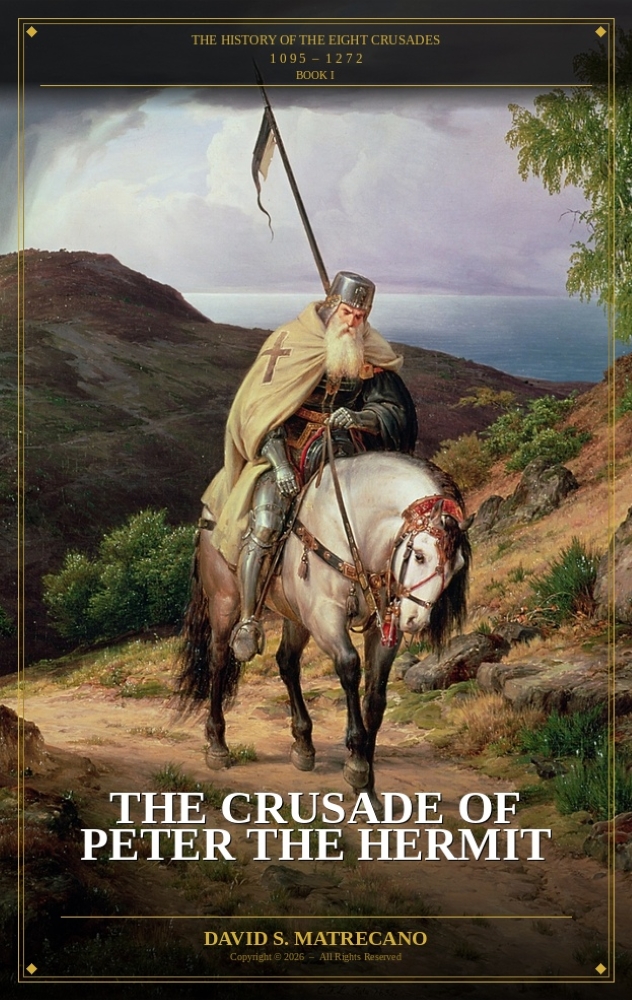
But the phenomenon nobody had calculated was the People's Crusade. Before the noble armies could organise, equip and set off in an orderly fashion, a wandering preacher called Peter the Hermit — who claimed to have received a letter from Heaven with divine instructions — was travelling across France and the Holy Roman Empire summoning the masses. Not the knights: everyone. Peasants, artisans, women, children, the elderly, beggars.
The result was an army of between fifty and one hundred thousand people — historians dispute the figures — that set off in the spring of 1096, months before the date the pope had set. Without adequate supplies. Without military strategy. Without professional leadership. With absolute faith and a cloth cross sewn onto their shoulder.
Along the road east, the People's Crusade perpetrated some of the most atrocious massacres of medieval history: the slaughter of Jews in the Rhine cities — Speyer, Worms, Mainz — in what historiography calls the first organised pogrom in Western Europe. Before reaching the enemy they had gone to fight, the crusaders had murdered thousands of innocents in God's name. In October 1096, what remained of that human tide was annihilated by the Seljuk Turks at Civetot, near Nicaea. Peter the Hermit survived because he was in Constantinople negotiating with Emperor Alexios.
The princes' armies: the Crusade that reached its goal
While the People's Crusade perished in Anatolia, the noble armies were organising with deliberate precision. Four main columns set out from different points across Europe between August and October 1096. Godfrey of Bouillon from Lorraine. Bohemond of Taranto from southern Italy. Raymond of Saint-Gilles from Provence. Robert of Normandy from the north. In total, between sixty and one hundred thousand warriors — of whom perhaps seven thousand were armoured knights.
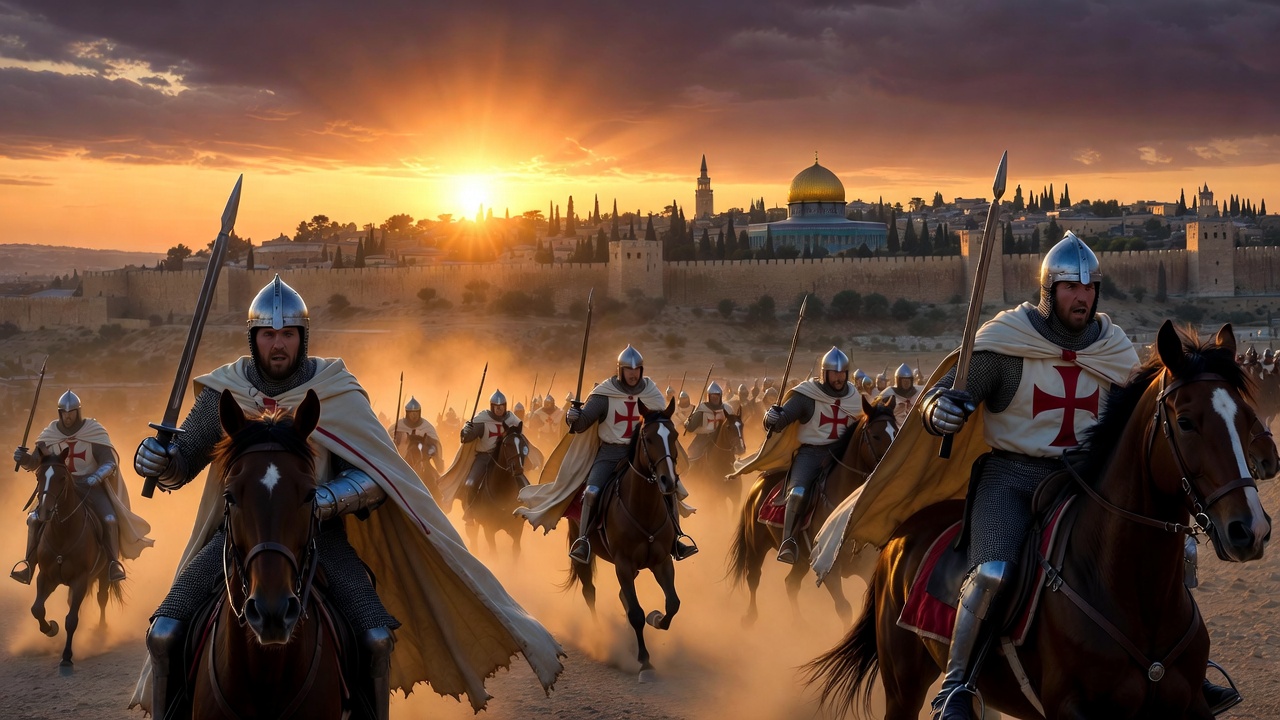
What followed was a three-year military campaign that defied all predictions. The crusaders took Nicaea in 1097. They won the Battle of Dorylaeum that same year. They survived the gruelling siege of Antioch in the winter of 1097–98, with devastating losses to hunger and disease, before conquering it in June 1098. And finally, on July 15th, 1099, they entered Jerusalem. The pope who had launched it all had died two weeks earlier — never knowing that his speech had changed the history of the world.
Two centuries that began with a single sentence
The First Crusade opened an era that would not close until 1291, when the last crusaders abandoned Acre under Mamluk fire. Two hundred years of military expeditions, of ephemeral kingdoms in the East, of monastic-military orders that changed the face of Europe and the Middle East forever.
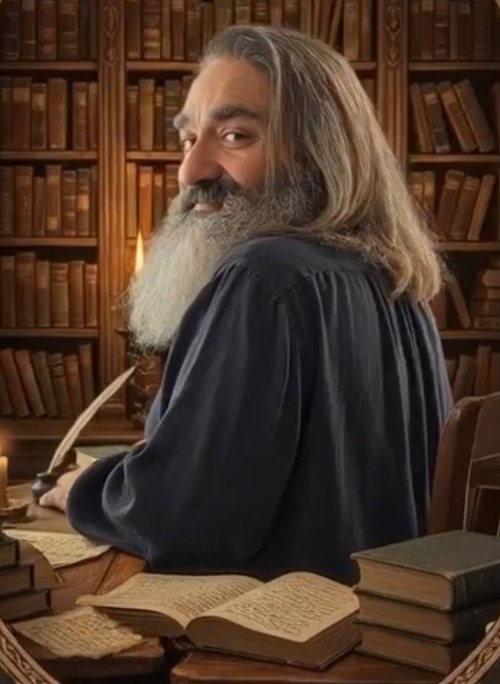
It all began with one man standing on a platform in a field outside Clermont, on a November day in 1095. A man who knew precisely which strings to pluck in the soul of his time, but who could not have imagined the magnitude of the seismic wave he was unleashing. That is what fascinates me as a writer: not the political calculation behind the speech, but the precise moment when words cease to belong to the one who speaks them and become history. That instant when the crowd cries "Dieu le veut" and nothing can stop what follows. That instant I narrate in La Cruzada de Pedro el Ermitaño.
Why were the Eight Crusades inevitable?
There are questions History poses with brutal clarity, and this is one of them: could the medieval world have avoided the Crusades? For years, while building my saga La Historia de las Ocho Crociate, I was compelled to answer it not as a distant historian, but as a narrator inhabiting the skin of crusaders, Saracens, hermit monks and kings. And the answer, however uncomfortable, is always the same: no. The Crusades were inevitable.
The unbearable weight of Jerusalem
Before Peter the Hermit walked the roads of France and the Rhineland summoning crowds with his incendiary eloquence, Jerusalem was already far more than a city. It was the centre of the Christian spiritual universe, the place where Christ had died and risen, the convergence point of pilgrimage, promise and forgiveness. For medieval man, losing access to Jerusalem was not a geopolitical defeat: it was a wound in the soul of the world.
In La Cruzada de Pedro el Ermitaño, I tried to capture exactly that moment: the instant when collective fervour surpassed any rational consideration. Peter did not invent the outrage — he channelled it. And that is the hallmark of truly inevitable historical movements: a single man does not create them, he precipitates them.
The Europe that needed a war
The Crusades were not born solely from faith. They were also born from a Europe simmering from within. At the end of the eleventh century, the continent was a system on the brink of social collapse. The custom of primogeniture left thousands of younger sons without land, title or future. The warrior nobility found in internal warfare an outlet that devastated Christian Europe itself.
Urban II's preaching at Clermont was an act of social engineering of extraordinary lucidity: it took that accumulated destructive energy and redirected it toward an external objective charged with sacred meaning. "Dieu le veut" — God wills it. In three words, the pope transformed war into penance, violence into virtue, and armed vagrancy into pilgrimage.
An expanding Islam and fear as engine
On the other side of the Mediterranean, the Islamic world was living its own moment of fracture and expansion. The Seljuk Turks had defeated the Byzantine Empire at Manzikert (1071) with a decisiveness that shook the foundations of Eastern Christendom. Byzantium was now desperately appealing to the West for help.
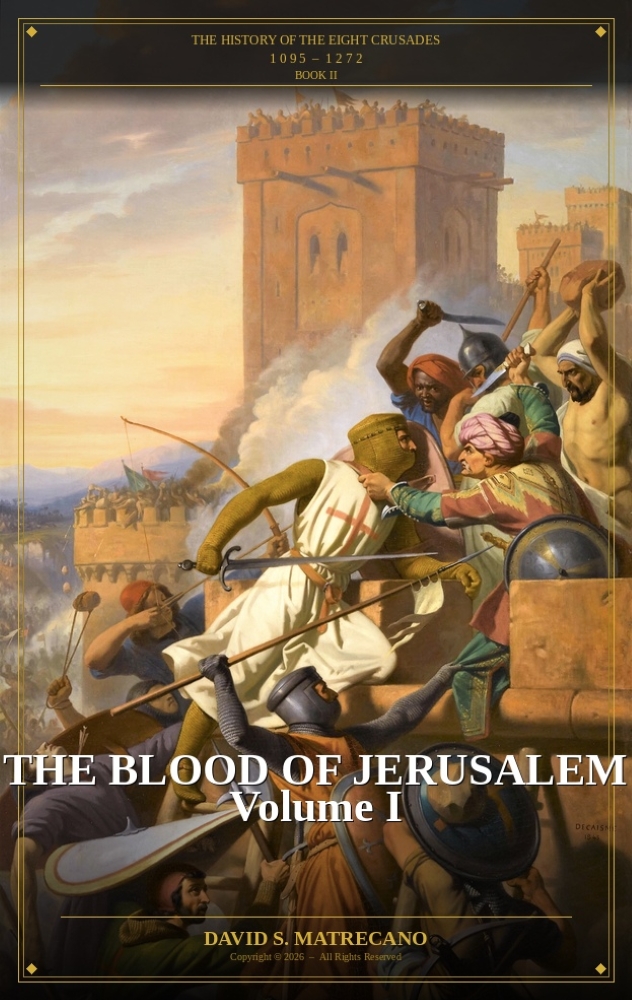
In La Sangre de Jerusalén, I explored that fear from within: the fear of warriors who knew they might die, who probably would die, and who marched nonetheless. Not out of madness, but because the alternative — standing still while the world closed in — seemed even more unbearable.
Faith as a real historical force
The most common mistake when analysing the Crusades from a modern perspective is underestimating faith. Economic, political or psychological motivations are always sought, as if religious fervour were a mask concealing something more "real". But for medieval man, God was not a metaphor: He was the explanation of everything, the first cause and the ultimate destiny. The promise of plenary indulgence made perfect sense within a completely coherent belief system. If you genuinely believed in purgatory, sin, grace and divine intercession, then embarking on the Crusade was the most rational decision you could make.
The Mediterranean as a structural battlefield
There is a geopolitical dimension to the Crusades that transcends religion: the Mediterranean as an arena of inevitable competition between civilisations. Venice, Genoa and Pisa financed Crusades not out of spiritual fervour but because having bases in the Levant served their interests. In El Amanecer de los Templarios, that dimension becomes the protagonist: the Knights Templar are not only warriors of Christ; they are also bankers, administrators of logistical networks and political actors on a board that has nothing simple about it.
Inevitable, yes. Justified?
That the Crusades were inevitable does not mean they were just. History rarely produces phenomena that are both comprehensible and innocent. The massacres of Jews along the Rhine, the sack of Constantinople in 1204, the raw violence of the siege of Jerusalem in 1099: all of it belongs to the same movement, its glories and horrors inextricably intertwined.
As a novelist, my task is not to judge but to understand. The Crusades were inevitable because they were the product of everything Europe and Islam were at that moment. And that is, perhaps, the most unsettling lesson they leave us: that History's great catastrophes are not caused by monsters. They are caused by us, when we are perfectly ourselves.
After Malta 1565: Lepanto 1571 — Christians Vs. Muslims
Mediterranean, 1565–1571 · From resistance to victory
In 1565, Malta resisted. In 1571, Europe struck back. The six years separating the Great Siege of Malta from the Battle of Lepanto are perhaps the most decisive period in the history of the modern Mediterranean — the moment when the tide changed direction, and the Ottoman Empire discovered that its dominion over the sea had a limit.
Malta 1565: the spark that ignited Europe
In September 1565, when the last Turkish ships abandoned Malta defeated and humiliated, the message that spread across Europe was unambiguous: the Ottoman advance had a limit. For the first time in decades, Christendom had withstood the greatest military effort of the Ottoman Empire — not in a great walled city, but on an arid island of 316 km², defended by a handful of Knights and soldiers who refused to yield.
As I recount in Malta: The Great Turkish Muslim Siege of 1565, that victory was not only military: it was the psychological trigger that made what came next possible. From Malta onwards, the Christian kingdoms of Europe began to think, for the first time since Constantinople, that an offensive alliance against Ottoman naval power was not only desirable — it was achievable.
The Holy League and the road to Lepanto
The man who turned that possibility into reality was Pope Pius V, a Dominican of iron character who had spent years trying to persuade the Christian princes to stop fighting each other and look to the common enemy. In May 1571, after months of negotiations, the Holy League was finally signed: a naval coalition between the papacy, the Republic of Venice and the Spanish Crown under Philip II. France, the other great Catholic power in Europe, was conspicuously absent — and not by chance: at that moment the French kings maintained a strategic alliance with the Ottoman sultan, their common enemy being the House of Habsburg. An alliance between a Christian kingdom and Islamic power that scandalised half of Europe, but which the French maintained without the slightest scruple.
The immediate trigger was the fall of Famagusta, Venice's last stronghold in Cyprus, in August 1571. The Venetian governor Marcantonio Bragadin, who had held out for eleven months with fewer than nine thousand men against an Ottoman army of eighty thousand, surrendered honourably after receiving promises of decent treatment. The Turkish commander Lala Mustafa had his ears and nose cut off, paraded him through the streets in a cage, then had him flayed alive and his skin stuffed with straw. That atrocity — which spread through every court in Europe — swept away the last hesitations of the allies.
The Holy League's fleet assembled at Messina in the summer of 1571: 227 galleys, 76 frigates, 6 galleasses — Venice's artillery-laden giants —, 1,815 cannon and more than 86,000 men. It was the greatest concentration of naval power the Mediterranean had seen since Antiquity.
Don John of Austria: the young man who stopped the world
Command of the entire fleet was given to Don John of Austria, the natural son of Emperor Charles V and half-brother of Philip II. He was twenty-four years old. He was handsome, charismatic and fully aware of the historical weight of what was being asked of him. He was not a seasoned commander of great naval battles — he was, above all, a man who knew how to inspire others to die for something.
It is no coincidence that Francesco Balbi da Correggio, the soldier who lived through the Great Siege of Malta from within and wrote the first direct account of those events, dedicated his book to Don John of Austria. The link between Malta and Lepanto was not only strategic — it was personal, narrative, almost symbolic: the same generation that had defended Malta would be the one to go to Lepanto to settle the account.
Don John toured the fleet before the battle, galley by galley, rallying the soldiers. He told them they had come to fight for the Cross and for the freedom of Europe. When the more cautious admirals proposed waiting or negotiating, he replied that he had come to fight, not to parley.
7 October 1571: the day in the Gulf of Patras
The Turkish fleet under Admiral Ali Pasha sailed out of Lepanto — the ancient Greek city of Naupactus — with some 280 vessels and more than 75,000 men. When the two armadas sighted each other in the Gulf of Patras off the western coast of Greece, both sides knew there would be no second chance.
The battle began at midday. The tactical key to the Christian victory was the six Venetian galleasses — enormous floating machines loaded with heavy artillery that the Turks had never encountered — positioned in the vanguard. Their broadsides shattered the Ottoman formation before the hand-to-hand combat even began. Ali Pasha died on his own flagship when it was boarded. His head was raised on a pike above the deck, and at the sight of it, the Turkish army collapsed.
Within a few hours the Ottoman fleet was destroyed: more than 200 ships sunk or captured, between 25,000 and 30,000 dead, and more than 15,000 Christian slaves freed from the oars of Turkish galleys. It was the most catastrophic naval defeat the Ottoman Empire had ever suffered. And it was the definitive end of the myth of its invincibility in the Mediterranean.
Miguel de Cervantes: the cripple of Lepanto
Among the 86,000 men who fought that day in the Gulf of Patras was a twenty-four-year-old Spanish soldier named Miguel de Cervantes Saavedra. He was ill with fever on the day of the battle — his companions advised him to stay below decks. He refused. He asked to be placed at one of the most exposed posts on the ship and fought throughout the battle.
As I recount in Malta: The Great Turkish Muslim Siege of 1565, commanding a small galley with six men under his orders, Cervantes attacked and boarded a Turkish galley. In the fighting that followed on the enemy deck he was hit twice by arquebus fire: once in the chest and once in the left hand. The wound to the hand was so severe that it left it permanently disabled. That young soldier who nearly died at Lepanto would be, decades later, the author of Don Quixote — the most important novel ever written in the Spanish language.
Cervantes always considered Lepanto the most important experience of his life. When literary critics of his era belittled his works, he would respond by pointing to his mutilated left hand: he had lost that hand "for the greater glory of the right one." The cripple of Lepanto. A nickname he wore with pride until the day he died.
Why Lepanto did not change everything
The victory at Lepanto was crushing in military terms. But history has its ironies: the Ottoman Empire rebuilt its fleet in less than two years. Venice, financially exhausted, signed a separate peace with the Turks in 1573, ceding Cyprus. Philip II was too occupied with Flanders and the Atlantic to exploit the victory in the eastern Mediterranean.
What Lepanto did change — forever and irrevocably — was perception. The western Mediterranean ceased to be the space of Turkish dominance it had been since the fall of Constantinople in 1453. Malta had opened the way in 1565: the small, arid island that refused to surrender showed that resistance was possible. Lepanto showed that victory was possible too. Together, the two battles closed the most threatening chapter of the long war between Islam and Christendom for control of the Mediterranean.
Baldwin IV: the leper king who defeated Saladin
Jerusalem, 1161–1185 · The most heroic life of the Middle Ages
Some lives defy all categories. That of Baldwin IV of Jerusalem is one of them. Crowned at thirteen, a leper from the age of nine, blind and paralysed at the end, he governed the most threatened kingdom in Christendom for more than a decade with a clarity and courage that none of his healthy contemporaries could match. And when he died, barely twenty-four years old, he left the throne in the hands of the only people capable of losing everything — and they did.
The dynasty: five kings named Baldwin
When Godfrey of Bouillon conquered Jerusalem in July 1099 at the head of the First Crusade, he refused the title of King of the Holy City — he would not wear a crown of gold where Christ had worn a crown of thorns. It was his brother Baldwin of Boulogne who, without such scruples, crowned himself Baldwin I in the year 1100, founding the dynasty that would rule the Kingdom of Jerusalem for nearly a century.
He was followed by Baldwin II (1118–1131), his cousin and one of the pillars of the young kingdom, who welcomed Hugues de Payens and his first nine knights into the Temple and saw the Templar Order born under his reign. Then came Baldwin III (1143–1163), who conquered Ascalon from the Egyptian Fatimids, and finally Baldwin IV (1174–1185), the most extraordinary of them all. Five kings with the same name. One single obsession: keeping alive the impossible dream of a Christian kingdom in the heart of Islam.
A boy, a diagnosis, a destiny
Baldwin IV was born in 1161, son of King Amalric I and Agnes of Courtenay. He was a sharp, intelligent and physically gifted child — his tutor, the historian William of Tyre, described him as an exceptionally brilliant pupil. It was William himself who discovered, when Baldwin was about nine years old, that the boy felt no pain when his right arm was pinched. Physicians were not slow to confirm the diagnosis: leprosy.
The disease would advance inexorably. First the right arm, then both hands, then the face. In time Baldwin would lose sight in one eye, then the other. In his final years he governed lying on a litter, his body wrapped in bandages, unable to ride a horse. And yet, for more than a decade, he was the man who kept the greatest military leader of medieval Islam at bay.
Montgisard, 1177: the miracle in the desert
On 25 November 1177, Saladin — the Ayyubid sultan who had reunified Egypt and Syria and dreamed of reconquering Jerusalem — was advancing northward with an army of twenty-five thousand men, convinced that the Christian kingdom lay defenceless. Baldwin IV was sixteen years old, his body already marked by leprosy, and he had fewer than five hundred knights and a few thousand infantry.
What happened at the Battle of Montgisard is one of the most extraordinary episodes in the history of the Crusading Wars. The young leper king, who could barely hold the reins with his bandaged hands, personally led the charge. The Saracen vanguard was surprised and destroyed. Saladin had to flee on horseback, leaving his dead on the field. He lost more than eight thousand men. The Kingdom of Jerusalem survived another day.
Saladin, who was a man of honour as well as a military genius, publicly acknowledged the defeat. And, according to the chronicles, he never forgot the young king who had defeated him in the desert with half his forces.
Governing with death overhead
What makes Baldwin IV truly unique is not merely the victory at Montgisard. It is his capacity to govern, with complete lucidity, a kingdom in a permanent state of war, surrounded by quarrelling nobles and newly arrived crusaders from Europe who understood nothing of local politics — all while his body progressively disintegrated.
Baldwin was fully aware that he would have no children. Leprosy and the treatments of the age made marriage and succession impossible. He knew he would die young and that the kingdom needed a succession plan. He therefore poured all his political energy into managing that succession — a problem that would ultimately destroy what he had built.
In 1180, in a moment of political weakness, he consented to the marriage of his sister Sibylla to an ambitious French noble freshly arrived from overseas: Guy de Lusignan. It would prove to be the most catastrophic decision of his reign.
Sibylla, Guy de Lusignan and the collapse
Sibylla of Jerusalem was intelligent, beautiful and unfortunately in love with Guy de Lusignan — a man described by contemporary chroniclers with devastating unanimity: handsome, chivalrous in appearance, and entirely unfit for government or war. The barons of the kingdom despised him. Baldwin himself eventually acknowledged his mistake and tried to annul the marriage and remove Guy from power, without fully succeeding.
Baldwin IV died in the spring of 1185, aged twenty-four, blind and consumed by disease. He had named as regent his nephew, the child Baldwin V, Sibylla's son from a previous marriage, under the tutelage of Count Raymond III of Tripoli. But Baldwin V would die barely a year later, in 1186. And then Sibylla, now a free widow, made a decision that would change history: she crowned herself Queen of Jerusalem, and immediately afterwards crowned Guy de Lusignan as king consort. The barons who opposed Guy could do nothing — the kingdom was Sibylla's, and Sibylla wanted Guy.
The Horns of Hattin: the end of the dream
On 4 July 1187, on the volcanic hills beside the Sea of Galilee known as the Horns of Hattin, Saladin destroyed the crusader army in the most decisive battle in the history of the Kingdom of Jerusalem. Guy de Lusignan had made a series of military decisions so catastrophically wrong that modern historians still debate whether they sprang from incompetence or treachery: he marched the entire army across arid terrain in the height of summer, without access to water, straight into the trap Saladin had set for him.
The True Fragment of the Holy Cross — the kingdom's most sacred relic, carried into battle as a symbol of divine protection — was captured by the Muslims. The Grand Master of the Templars, Gerard of Ridefort, was taken prisoner. Guy de Lusignan was captured and brought before Saladin, who offered him water and spared his life. That same day, however, Saladin had personally drawn his scimitar and beheaded the French lord Raynald of Châtillon — the lord of Kerak, guilty of attacking an Arab merchant caravan and murdering Saladin's own sister during the raid. It was a blood debt the sultan had been waiting years to settle, and the battle of Hattin had delivered it on a silver platter. Three months later, on 2 October 1187, Saladin entered Jerusalem.
What Baldwin IV had defended with his shattered body for more than a decade — the impossible equilibrium, the constant negotiation, the calculated resistance — was lost in a single summer day through the vanity and incompetence of the man his sister had chosen as king. The lesson history offers is cruel and direct: sometimes the sickest man in the room is the only one who thinks clearly.
Herodotus: father of history or father of lies?
Halicarnassus, 484 BC · The man who invented History
Two and a half thousand years ago, a Greek born in Halicarnassus decided to travel the known world from end to end, speak to everyone he met, note down everything he saw, heard or was told — and write it all. His name was Herodotus of Halicarnassus, and what he wrote changed forever the way human beings remember the past.
A curious boy in Halicarnassus
In 484 BC, in the Greek city of Halicarnassus — a Doric colony on the western coast of present-day Turkey, under Persian rule for over a century — a boy was born to whom his parents, Lyxes and Dryo, gave the name Herodotus. He was extraordinarily curious, intelligent and possessed of that restless wandering spirit found only in truly free souls. No one at that moment could have imagined that this boy would become the first historian of humanity as we understand the word today.
His life began with political turbulence. His cousin Panyassis was executed for treason by the local tyrant Lygdamis II, a Persian puppet. The young Herodotus was forced to flee hastily to the island of Samos to save his life. That forced exile was, paradoxically, the greatest gift destiny could have given him: it set the whole world before him.
The greatest traveller of Antiquity
With the financial means provided by his wealthy family, Herodotus undertook a journey no Greek of his era had ever dreamed of. He visited all of mainland Greece, the Aegean islands, southern Italy, the Balkans, the Black Sea, Turkey, Syria, Lebanon, Israel, Egypt, Libya and all of Persia — present-day Iran and Iraq. It was in Athens that he frequented Pericles, the sculptor Pheidias and the poet Sophocles. In Egypt he travelled the country from north to south, fascinated by its temples, pharaohs, sacred river and customs.
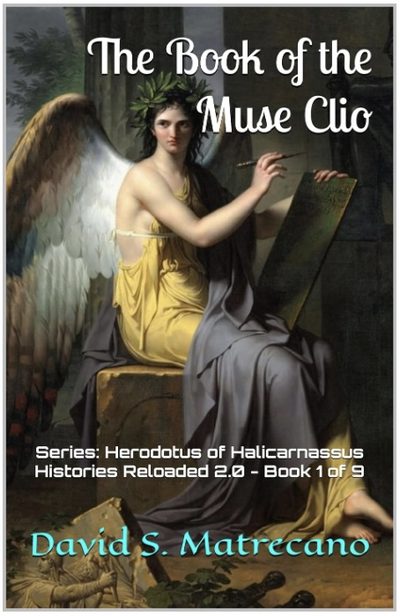
Around 430 BC, settled in the Italian colony of Thurii in Calabria, he wrote the Nine Books of History, known today simply as the Histories. Each carried the name of one of the nine Greek Muses: Clio, Euterpe, Thalia, Melpomene, Terpsichore, Erato, Polyhymnia, Urania and Calliope. He died around 425 BC, not knowing his work would last two and a half millennia.
Father of History or Father of Lies?
The question has been open for centuries. The title Father of History — History with a capital H — was given to him by Cicero himself, and with good reason: Herodotus was the first to make the systematic investigation of past events a discipline with its own methodology. Before him there were only myths, epics and royal propaganda. He wanted to know what really happened, how and why.
But his critics were not slow to arrive. Plutarch, four centuries later, bluntly called him "father of lies". The charge has a real basis: Herodotus writes about flying serpents in Arabia, about ants the size of foxes that dig for gold in Persia, about Phoenicians who circumnavigated Africa with the sun on their right instead of their left. He mixes what he saw with what he was told, and what he was told with what he suspected was interesting.
"Master, with all due respect, a small clarification is needed here: when you make mistakes, you do so always with the best intentions — to tell us something new and interesting. There is no bad faith. There is overflowing enthusiasm, not always reliable local sources, and the inevitable limits of fifth-century BC knowledge."H. "David, I write what I am told and what I see. If the priests of Memphis tell me that the crocodile is a sacred animal that weeps crocodile tears as it devours its prey, I note it down. My readers will decide."
Clio: Greece, Persia and the origins of conflict
The first book, dedicated to the Muse Clio, opens with the prehistory of the conflict between Greece and the East: the abduction of Princess Io of Argos by Phoenician sailors, the kidnapping of Europa from Tyre, of Medea from Colchis, and finally of Helen from Sparta. For Herodotus, the Trojan War and the Persian Wars are chapters of the same unfinished book.
The great protagonist of the Muse Clio is Croesus, the enormously wealthy king of Lydia, whose conversation with the Athenian sage Solon about human happiness is one of the most memorable passages in all ancient literature. Then comes Cyrus the Great, the founder of the Persian Empire, raised by shepherds after his grandfather Astyages had ordered him killed at birth. And the terrible revenge of Harpagus, the general whom Astyages forced to eat the flesh of his own son at a banquet.
Herodotus is not merely a chronicler: he is a storyteller. He knows exactly when to slow the pace, when to add a detail that makes the skin crawl, when to let the reader draw their own conclusions.
Euterpe: Ancient Egypt and its secrets
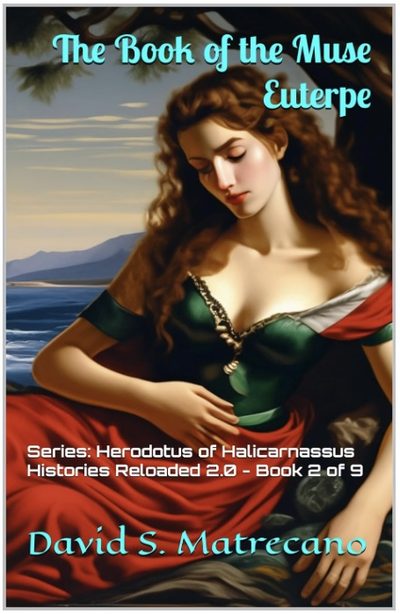
The second book, the Muse Euterpe, is a treatise on Ancient Egypt that remains, two and a half millennia later, one of the most valuable documents we possess about that world. Herodotus travelled it in person: he sailed up the Nile, visited the temples, spoke with priests, observed embalming customs, noted the sacred animals — the crocodile, the ibis, the cat, the cobra — and asked about the pharaohs.
His Egyptian sources were not always reliable. He wrote that Pharaoh Cheops prostituted his own daughter to finance the Great Pyramid. That Pharaoh Psamtik I had two children raised without human contact to discover which was humanity's first language. That Helen of Troy and Paris, on their way to Troy, were stranded on the Egyptian coast by a storm — and that the real Trojan War was fought over a woman who was never there.
In my adaptation Herodotus: Histories Reloaded 2.0, I have corrected, expanded and contextualised all these episodes with the archaeological and historical knowledge of the twenty-first century, dialoguing directly with the Master in those small exchanges that punctuate the text and which are, for many readers, the most entertaining part of the books.
Why Herodotus remains indispensable
The question with which this article opens — father of history or father of lies? — has an honest answer: both at once, and precisely for that reason he remains irreplaceable. A historian who only records the verifiable produces a register. A narrator who mixes data, rumour, myth and personal observation produces something far harder to manufacture: a living image of the ancient world.
Without Herodotus we would never have heard of Candaules, the perverted king who lost his life for showing his naked wife to his bodyguard. We would not know the Zoroastrian customs and practices of the Persians. We would have no first-hand description of fifth-century BC pharaonic Egypt. We would not know that a single Spartan, named Lacrineus, appeared before Cyrus the Great to tell him to his face not to dare touch any Greek city. Films like 300, Troy, Prince of Persia, Disney's Hercules — they all come from him.
When Europe was saved on an island: the Great Siege of Malta
Malta, May–September 1565 · The battle that saved the West
In the summer of 1565, on a barren island of barely 316 km² in the centre of the Mediterranean, a few hundred Christian knights and soldiers stopped the greatest military effort of the Ottoman Empire. What happened there over those four months of fire, blood and blind faith did not only save Malta: it saved Europe.
Suleiman I and the wager of the century
In the spring of 1565, Sultan Suleiman I the Magnificent — the man who had conquered Rhodes, Budapest and Baghdad — unleashed on the small island of Malta the most powerful armada the Mediterranean had seen in generations: two hundred warships, forty thousand men, the finest generals of the Ottoman Empire. At the head of the land army: the veteran and ruthless Mustafa Pasha. At the head of the fleet: Admiral Piali Pasha. And as military adviser, the legendary corsair Dragut Reis, King of Tripoli, the most feared of all Muslim pirates in the Mediterranean.
The reason for the attack was clear: Malta, governed by the Hospitaller Order of the Knights of Saint John, was the key to the western Mediterranean. If Malta fell, the road to Sicily, Italy and the heart of Europe lay open. For Suleiman, it was not an option — it was a historical necessity.
Jean Parisot de La Valette: the old Lion
Against forty thousand Ottoman soldiers, Malta could muster barely eight thousand men: some six hundred Knights of the Order and between seven and eight thousand regular soldiers, mercenaries and Maltese militiamen. The man who had to lead that impossible defence was Grand Master Jean Parisot de La Valette, a noble French knight of seventy-one, who had spent more than half a century fighting Islam on land and sea, and who had experienced Turkish slavery first-hand — he had spent a year as a galley slave chained to the oars of an Ottoman galley.
La Valette was exactly the man the situation demanded. Cold, implacable, deeply religious and militarily brilliant. When his captains suggested evacuating the less defensible positions, he responded with a phrase that would be etched into the history of the siege: the Knights of Malta do not surrender, nor do they retreat.
The ordeal of Fort Sant'Elmo
The siege began on 18 May 1565. The Turks chose to attack Fort Sant'Elmo first — a small stone star commanding the entrance to the Grand Harbour. Their calculation was that Sant'Elmo would fall in four or five days. It lasted forty.
For more than a month, the fort's defenders — mostly volunteer knights who knew they would not come out alive — withstood bombardments of an intensity contemporaries described as Dantesque. Dragut Reis himself would be killed by a shell splinter during operations against Sant'Elmo, robbing the Ottomans of their best military mind at the most critical moment.
On Saturday, 23 June 1565, when the last defenders of Sant'Elmo could no longer stand, the Turks took the fort. Of the six hundred men who had defended it, not one survived. Mustafa Pasha, furious at the price he had paid for that small fortress, ordered the knights' bodies to be mutilated and cast into the sea in the shape of crosses, as a message to the Grand Master. La Valette responded by ordering all Turkish prisoners to be beheaded and their heads fired as cannonballs into the enemy camp.
Birgu and Senglea: where the legend was born
After the fall of Sant'Elmo, the Turks concentrated their full firepower on the two remaining Christian strongholds: the Borgo (Birgu) and Senglea. The bombardment was so intense and unrelenting that eyewitnesses described the ground as literally churned by the impacts. The defenders — by now mostly wounded, sick or exhausted — fought with a determination that left the attackers themselves bewildered.
The darkest moment of the siege came on 7 August, when the Turks launched what seemed to be the final, decisive assault. At that moment of utmost desperation, the cavalry of Mdina — barely a hundred horsemen and a hundred foot soldiers — attacked the Turkish camp and hospital from the rear, sowing panic among the assailants. The cry of "victory, victory, relief, relief!" swept through all the Christian posts, and the Turks, believing the Spanish Grand Relief had arrived, withdrew in disorder. Two thousand Ottoman casualties that single day.
The Grand Relief and the retreat
Finally, in the night of 6 to 7 September, Don García de Toledo silently landed the Spanish Grand Relief on the small island of Gozo and from there onto Malta: some nine thousand fresh soldiers. The following day, 8 September, feast of the Nativity of the Virgin, all the munitions were inside the city. By 9 September not a single Turk remained in the trenches. By the 10th, Maltese civilians and relief soldiers were walking freely over ground that for four months had been a battlefield.
The Ottomans had lost between twenty and twenty-five thousand men. The "invincible armada" of Sultan Suleiman I returned to Istanbul defeated, humiliated and decimated. Malta, with just a handful of men, had contained the greatest military effort of the Ottoman Empire in the western Mediterranean. Europe breathed again.
Why Malta changed the history of the West
Malta's victory in 1565 was not merely a military feat — it was a psychological and strategic turning point. It proved that the Ottoman advance had a limit. It inspired the formation of the Holy League which, six years later, would inflict on the Turks the definitive defeat at Lepanto (7 October 1571), closing forever the threat of an Islamic conquest of the western Mediterranean.
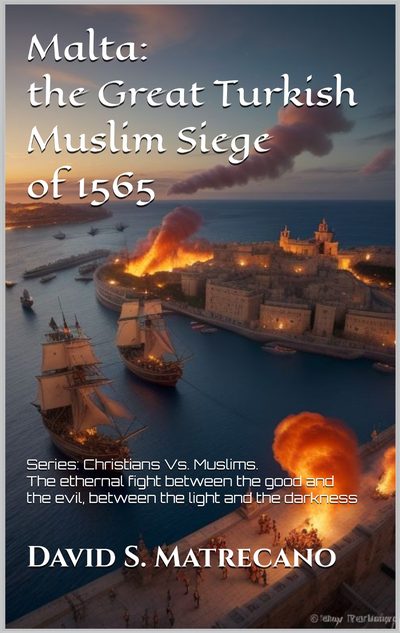
As I recount in Malta: The Great Turkish Muslim Siege of 1565, drawing on the original account of Francesco Balbi da Correggio — a soldier who lived the siege from within — what happened on that small, arid island was not simply the defence of a territory. It was the defence of a civilisation. And the men who lived it, the Knights as well as the Maltese soldiers and anonymous mercenaries, deserve to be remembered.
The destruction of the Temple: betrayal or conspiracy of State?
Friday, 13 October 1307 · The day a legend ended
At dawn on Friday, 13 October 1307, agents of the King of France burst simultaneously into every Templar commandery in the kingdom. Within hours, hundreds of Knights Templar had been arrested on fabricated charges, invented expressly to justify their destruction. The most powerful order in Christendom, which had survived two centuries of war in the Holy Land, was annihilated in a single day. Not by the Saracen sword. By the conspiracy of two men: Philip IV the Fair, King of France, and Clement V, Pope — also French.
Philip IV the Fair: debts, power and greed
To understand the destruction of the Temple one must understand Philip IV of France, known as the Fair — an epithet history has granted him with some irony, for few medieval figures were as cold, calculating and ruthless as he was. Philip was an absolutist king avant la lettre: he wanted a centralised, obedient and wealthy state. And he had a serious problem: he was deeply indebted to the Templars.
The Temple had evolved from its military origins to become the most sophisticated bank in Europe. It managed fortunes, lent money to kings and popes, and maintained a financial network stretching from Lisbon to Acre. Philip owed them astronomical sums for the wars he had waged. Eliminating the Templars meant, among other things, cancelling his debt at a stroke.
But money was only part of the equation. Philip also wanted the order's immense landed wealth — castles, lands, commanderies scattered across France and the Mediterranean. And he wanted something harder to quantify: to eliminate an autonomous power that answered not to him but to the pope, and that represented a state within the state.
Clement V: the French pope who obeyed
To execute his plan, Philip needed the pope. And he had the fortune — or the skill — of having one entirely at his mercy. Clement V, born in Gascony in southern France, was a man of frail health and even frailer will. From 1309 he resided in Avignon, on territory controlled by the French Crown, far from Rome and completely surrounded by Gallic influence. He was, in practice, a captive pope.
Clement V not only consented to the persecution of the Templars — he endorsed it, legitimised it and extended it to the rest of Christendom. It was he who convened the Council of Vienne in 1311–1312, where the order was officially suppressed by the bull Vox in excelso. Not because the charges had been proven — they never were — but for the good of the peace of the Church, as the text stated. A formulation which, in plain English, means: because the King of France demanded it.
The charges: the weapon of infamy
The charges against the Templars were designed to scandalise, not to be true. They were accused of denying Christ during initiation rites, of spitting on the cross, of worshipping a demonic idol called Baphomet, of practising obscene acts and sodomy. These were exactly the kind of accusations that in the Middle Ages sufficed to destroy a reputation — impossible to refute without appearing guilty, impossible to admit without being so.
Confessions were extracted under torture. The Inquisition, directed in France by Guillaume de Nogaret — Philip's man, not the pope's — applied methods that made resistance virtually impossible. Many Templars confessed to everything demanded of them. Many later recanted, when it was already too late. Some died at the stake for refusing to comply.
On 18 March 1314, Jacques de Molay, the last Grand Master of the Temple, was burned at the stake on the Île de la Cité, before the cathedral of Notre-Dame. According to legend, from the flames he cursed the king and the pope, summoning them before God's tribunal before the year was out. Philip IV died in November 1314. Clement V had died in April. The curse, true or not, became part of the myth.
Betrayal or conspiracy of State?
The answer that history offers, two centuries on, is clear: it was a conspiracy of State. There was no internal betrayal — there is no serious evidence that the Templars practised any heresy. There was royal ambition, papal weakness, and a judicial machinery placed at the service of political power. Friday, 13 October 1307 was not the date on which an order's corruption was uncovered — it was the date on which one of the greatest institutional injustices of the medieval age was perpetrated.
The popular superstition about "Friday the 13th" as an unlucky day has its most widely cited origin precisely here. An indebted king, a compliant pope, and two centuries of history erased with a stroke of the pen and the fire of the Inquisition. In The Dawn of the Templars, the shadow looming on the horizon — the fragility of what Hugues de Payens had founded at such cost — is an essential part of the saga's atmosphere. Because great institutions not only are born: they also die. And sometimes, in the worst way imaginable.
Hugues de Payens: the man who founded the Templar Order
Jerusalem, circa 1119 · The origin of a legend
Around 1119, in the freshly conquered Jerusalem, nine knights presented themselves before King Baldwin II with an extraordinary proposal: they wished to live as monks — taking vows of poverty, chastity and obedience — while continuing to carry the sword. What was born from that audience was the most powerful, mysterious and enduring religious order in Western history. And the man who conceived it was called Hugues de Payens.
A knight from Champagne in the Holy Land
We know surprisingly little about Hugues de Payens' early life. He was born around 1070 in the Champagne region of north-eastern France, into a minor noble family. He was a cousin of the Count of Champagne — who was also called Hugues, Hugues I of Champagne —, one of the most powerful feudal lords of the age. The two Hugues shared not only their name but a deep friendship and the same spiritual restlessness that would lead them, together, to the Holy Land. In 1104, cousins and close friends, they made their first journey to Jerusalem side by side, as I recount in The Dawn of the Templars. It was that first encounter with the reality of Outremer — the violence of the pilgrimage routes, the fragility of the newly conquered Kingdom of Jerusalem — that planted in Hugues de Payens the seed of what would one day become the Temple.
To all this one must add a detail that history tends to overlook: Hugues de Payens was a widower and had a daughter. The man who would found the most celebrated monastic-military order in the world had known first-hand the texture of family life, loss, and the loneliness that follows. He was not a young idealist fleeing the world. He was a mature man, shaped by experience, who consciously chose to consecrate himself to something greater than himself.
What we do know is that by around 1115 he was already moving in the innermost circles of power in the Kingdom of Jerusalem. And that he had been nurturing an idea for some time: to create an institution that would combine monastic discipline with military capability. A monk-soldier. A warrior of God.
The nine knights and the king
The founding of the Temple is a story of calculated audacity. Hugues gathered eight trusted companions — among them his brother-in-law Godfrey of Saint-Omer — and presented themselves to Baldwin II with an official mission: to protect the pilgrimage routes between the port of Jaffa and the Holy City. Pilgrims arriving in the Holy Land were dying by the dozens on roads infested with Saracen bandits. The proposal was reasonable. The king accepted.
Baldwin II granted them a wing of the royal palace situated on the Temple Mount, where it was believed Solomon's stables had once stood. Hence the name they adopted: Pauperes commilitones Christi Templique Salomonici — the Poor Fellow-Soldiers of Christ and of the Temple of Solomon. The Templars.
The mystery surrounding those first nine years — from the foundation until the Council of Troyes in 1129, where the order received its official Rule — fed centuries of speculation. What were they really searching for beneath the Temple? What did they find? Serious historiography cannot answer these questions because the sources do not permit it. But that very darkness is precisely what makes Hugues and his companions figures who resist the passage of time.
Bernard of Clairvaux and legitimacy
Hugues's masterstroke was both political and spiritual — and, according to tradition, also a family matter. Bernard of Clairvaux, the future Saint Bernard, is said to have been Hugues's maternal uncle. If this tradition holds true, the man who persuaded Europe to rally behind the Temple was not an external ally: he was blood of the same blood. Convincing Bernard of Clairvaux, the most influential monk in Europe, to place his intellectual authority at the service of the new order was, in any case, the decisive move. Bernard not only supported the Templars — he wrote them the treatise De laude novae militiae, "In Praise of the New Knighthood", in which he theologically justified the paradox of the monk-soldier: he who dies in battle dies a martyr; he who kills the infidel commits not homicide but "malicide", the destruction of evil.
With Bernard's backing, Hugues attended the Council of Troyes in 1129. There the order received its official Rule, inspired by that of the Cistercians. And there, too, Hugues was formally appointed as the first Grand Master of the Order of the Temple. He was around 60 years old.
The man behind the legend
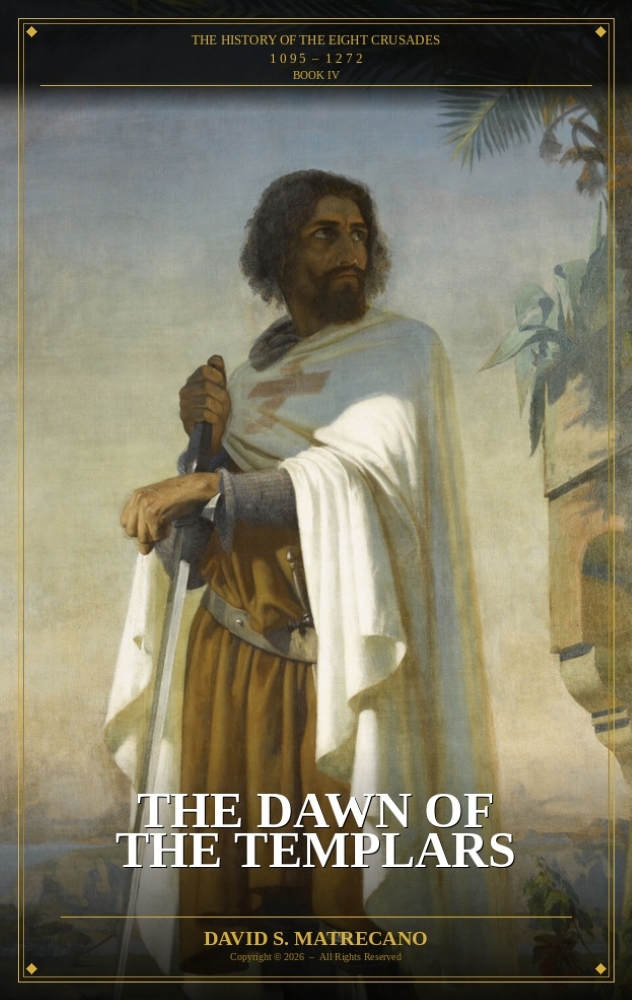
In The Dawn of the Templars, the fourth book in my saga about the Crusades, I tried to bring this elusive man to life. Not the myth — the man. A knight growing old, who had witnessed the violence of the Holy Land from within for decades, and who had conceived something utterly new: an institution capable of sustaining Christian presence in the East not merely through brute force, but through discipline, organisation and fraternal solidarity.
Because the Temple of Hugues was not the financial and political institution it would become a century later. At its origins it was something more austere and more intimate: nine men who had chosen to live at the edge of contradiction, between the sword and the cross, between the world and the cloister. The contradiction did not destroy them. It defined them.
Hugues de Payens died in 1136, most likely in the Holy Land. He did not live to see either the splendour or the fall of what he had founded. But he left something that no power could easily erase: an idea. The idea that faith and the sword are not incompatible. The idea that poverty and power can coexist. The idea that nine men, with sufficient determination, can change the course of history.
Español · Italiano · Français · Português · Deutsch