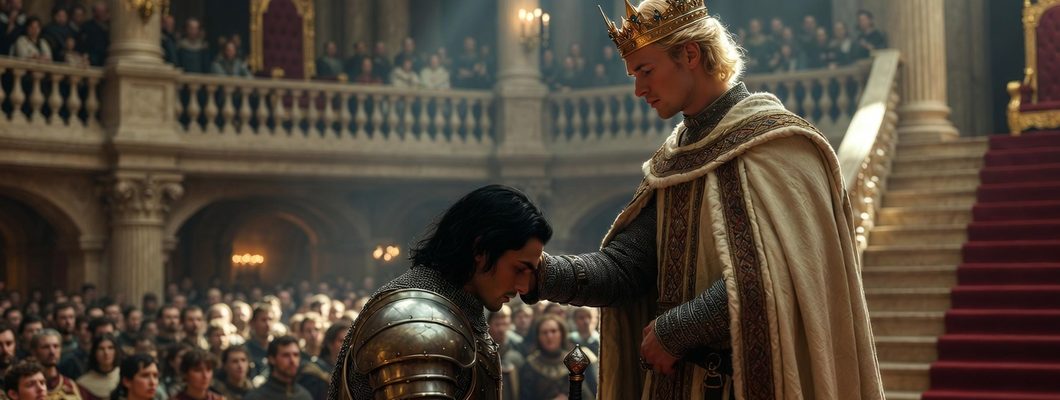
At dawn on Friday, 13 October 1307, agents of the King of France burst simultaneously into every Templar commandery in the kingdom. Within hours, hundreds of Knights Templar had been arrested on fabricated charges, invented expressly to justify their destruction. The most powerful order in Christendom, which had survived two centuries of war in the Holy Land, was annihilated in a single day. Not by the Saracen sword. By the conspiracy of two men: Philip IV the Fair, King of France, and Clement V, Pope — also French.
Philip IV the Fair: debts, power and greed
To understand the destruction of the Temple one must understand Philip IV of France, known as the Fair — an epithet history has granted him with some irony, for few medieval figures were as cold, calculating and ruthless as he was. Philip was an absolutist king avant la lettre: he wanted a centralised, obedient and wealthy state. And he had a serious problem: he was deeply indebted to the Templars.
The Temple had evolved from its military origins to become the most sophisticated bank in Europe. It managed fortunes, lent money to kings and popes, and maintained a financial network stretching from Lisbon to Acre. Philip owed them astronomical sums for the wars he had waged. Eliminating the Templars meant, among other things, cancelling his debt at a stroke.
But money was only part of the equation. Philip also wanted the order's immense landed wealth — castles, lands, commanderies scattered across France and the Mediterranean. And he wanted something harder to quantify: to eliminate an autonomous power that answered not to him but to the pope, and that represented a state within the state.
Clement V: the French pope who obeyed
To execute his plan, Philip needed the pope. And he had the fortune — or the skill — of having one entirely at his mercy. Clement V, born in Gascony in southern France, was a man of frail health and even frailer will. From 1309 he resided in Avignon, on territory controlled by the French Crown, far from Rome and completely surrounded by Gallic influence. He was, in practice, a captive pope.
Clement V not only consented to the persecution of the Templars — he endorsed it, legitimised it and extended it to the rest of Christendom. It was he who convened the Council of Vienne in 1311–1312, where the order was officially suppressed by the bull Vox in excelso. Not because the charges had been proven — they never were — but for the good of the peace of the Church, as the text stated. A formulation which, in plain English, means: because the King of France demanded it.
The charges: the weapon of infamy
The charges against the Templars were designed to scandalise, not to be true. They were accused of denying Christ during initiation rites, of spitting on the cross, of worshipping a demonic idol called Baphomet, of practising obscene acts and sodomy. These were exactly the kind of accusations that in the Middle Ages sufficed to destroy a reputation — impossible to refute without appearing guilty, impossible to admit without being so.
Confessions were extracted under torture. The Inquisition, directed in France by Guillaume de Nogaret — Philip's man, not the pope's — applied methods that made resistance virtually impossible. Many Templars confessed to everything demanded of them. Many later recanted, when it was already too late. Some died at the stake for refusing to comply.
On 18 March 1314, Jacques de Molay, the last Grand Master of the Temple, was burned at the stake on the Île de la Cité, before the cathedral of Notre-Dame. According to legend, from the flames he cursed the king and the pope, summoning them before God's tribunal before the year was out. Philip IV died in November 1314. Clement V had died in April. The curse, true or not, became part of the myth.
Betrayal or conspiracy of State?
The answer that history offers, two centuries on, is clear: it was a conspiracy of State. There was no internal betrayal — there is no serious evidence that the Templars practised any heresy. There was royal ambition, papal weakness, and a judicial machinery placed at the service of political power. Friday, 13 October 1307 was not the date on which an order's corruption was uncovered — it was the date on which one of the greatest institutional injustices of the medieval age was perpetrated.
The popular superstition about "Friday the 13th" as an unlucky day has its most widely cited origin precisely here. An indebted king, a compliant pope, and two centuries of history erased with a stroke of the pen and the fire of the Inquisition. In The Dawn of the Templars, the shadow looming on the horizon — the fragility of what Hugues de Payens had founded at such cost — is an essential part of the saga's atmosphere. Because great institutions not only are born: they also die. And sometimes, in the worst way imaginable.
Sources and references
- Trials of the Temple (1307–1314) — records preserved in the Vatican Archive.
- Bull Vox in excelso by Clement V (1312) — suppression of the Order.
- Chronicle of Geoffroi de Paris — account of 13 October 1307.
There is no fiction in this article
It is all in the records: the simultaneous arrests of Friday 13 October 1307 ordered by Philip IV, the interrogations, the suppression of the Order at the Council of Vienne by the bull Vox in excelso of 1312 and the burning of Jacques de Molay in 1314. The originals are kept in the Vatican Archive and the account of the raid was written down by Geoffroi of Paris. The confessions were torn out under torture, and it is not this article that says so: the Templars themselves said it the moment they were off the rack, when almost all of them retracted. As for motive, no document reads “I did it for the money”; but the king owed the Temple a fortune, kept its property, and the man who ran the trial was his keeper of the seals, Guillaume de Nogaret — the same one who years earlier had gone to Anagni for the pope. The narrator's conclusions belong to the personal literary voice of the author, David S. Matrecano.