After the conquest of Jerusalem on July 15, 1099, the Holy Land found no peace. Intrigues, power struggles and dangerous roads threatened the fragile Latin Kingdom from the very first day. While Godfrey of Bouillon —elected Advocatus Sancti Sepulchri— died barely a year later, his brother Baldwin had to confront the unbridled ambition of Patriarch Daimbert of Pisa, who wanted no less than theocratic control of Jerusalem.
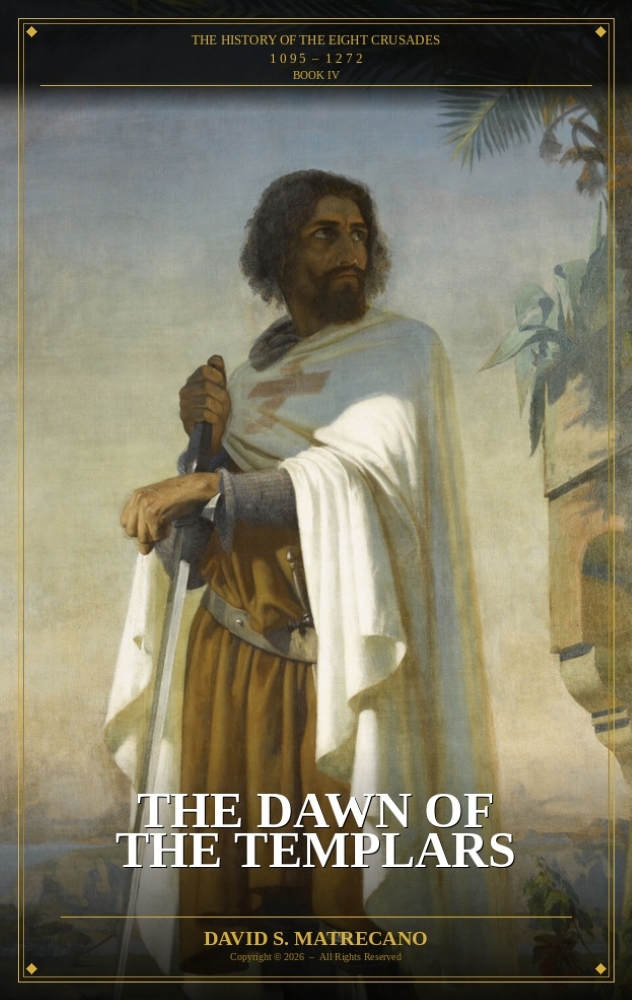
Into this convulsed scene steps Hugues de Payens, French nobleman, widower, man of faith and of the sword, who arrives in the Holy Land in 1104 seeking spiritual meaning… and finds a mission. Contact with the brutal reality of Palestine —the ambushes, the fragility of the Kingdom, the lack of escort for defenseless pilgrims massacred a few kilometers from the Holy City— plants in his mind a revolutionary idea: to create a brotherhood of warrior monks who would consecrate their lives to protecting the sacred roads.
With eight companions, all French nobles, Hugues presents himself before King Baldwin II and proposes the formula: poverty, chastity, obedience, and the sword in service of the pilgrim. The king grants them part of the Temple of Solomon —today's Dome of the Rock— as their quarters, and from there they take the name by which they will go down in history: the Knights of the Temple. It is 1119. The Templars are born.
The book reconstructs with meticulous detail the following decades: the consolidation of the Order thanks to the patronage of Saint Bernard of Clairvaux, its Rule approved at the Council of Troyes (1129), the spectacular military and financial growth, and the great military milestones such as the battle of Montgisard (1177), where the leper king Baldwin IV and the Templars humiliated Saladin, or the battle of the Spring of Cresson (1187), where Gerard of Ridefort led the Order to disaster.
But the dream ends at the Horns of Hattin on July 4, 1187: Saladin annihilates the crusader army, personally beheads the traitor Raynald of Châtillon, and two months later reconquers Jerusalem. The first Latin Kingdom collapses. But the legend of the Templars is barely beginning. There is no myth here yet. Only the dawn. And like every dawn, it carries in its light the seed of future greatness… and also of its fall.