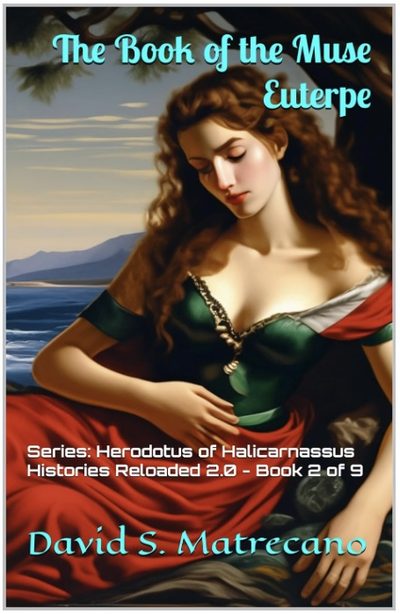
Herodotus of Halicarnassus (c. 484 — c. 425 BC) was the first man to write what we today call History. Before him, the Greeks recounted the past as myth, as divine genealogy or as dynastic propaganda. Herodotus invented something new: to travel, to ask, to compare testimonies, to write what each side claims. He traveled to Egypt, Babylon, Scythia, Magna Graecia. He noted every version —Greek, Persian, Phoenician— without imposing a single verdict. From that method was born his monumental work, the Histories, today divided into nine books, each under the name of a Muse.
But Herodotus's Greek is now inaccessible to the average reader. Academic editions are dense, heavy, with thousands of footnotes. For centuries the general public has missed the most extraordinary narrative raw material that Antiquity produced: the wars that decided whether the West would be Greek or Persian.
The Italian historian and novelist David S. Matrecano, based in Ibiza, devotes his second saga to rescuing Herodotus from oblivion. Through a "contextual modernization" —the same method with which he has rewritten the history of the Crusades— he takes the original matter of the Halicarnassian and pours it into prose that is alive, rhythmic, accessible, without losing a single verifiable fact.
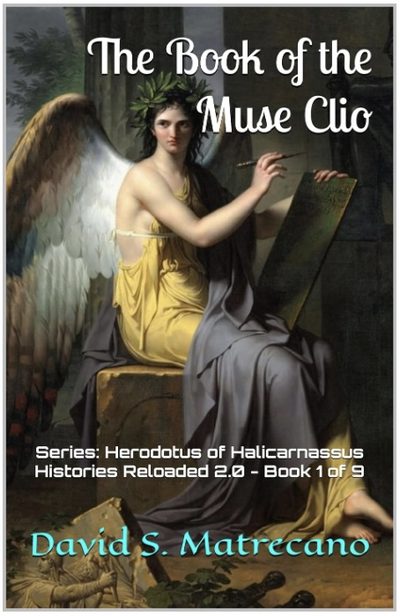
This first volume, The Book of the Muse Clio, covers the first part of the Herodotean Histories, which in the original work occupies Books I to V: from the mythical origins of the conflict between East and West —the rape of Helen, the Lydian dynasties, the fall of Croesus to Cyrus, the Persian conquest of Egypt and Babylon— up to the battle of Marathon, where a handful of Athenians win the first great Greek victory against the Persian colossus.
If you have read classic historical fiction —Pressfield's Gates of Fire, Gore Vidal's Creation, Madeline Miller's Song of Achilles— this book will give you the real historical basis on which they are built. If you come from another genre, you will discover here a world of heroes, gods, traitors and kings that surpasses any invented fiction. Absolute historical rigor. Narrative impossible to put down.