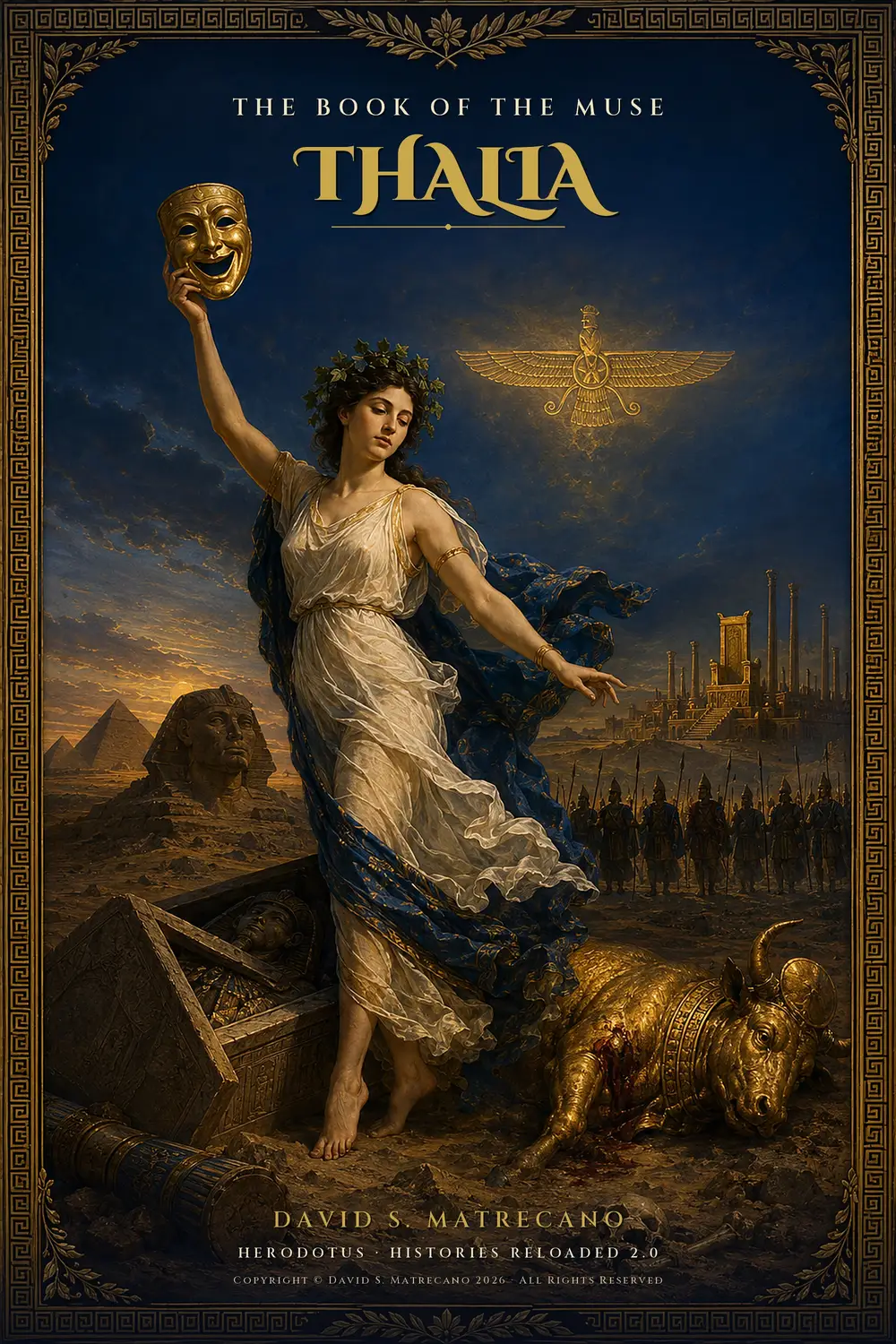
Herodotus dedicated the third book of his Histories to Thalia, the muse of comedy — an ironic dedication for the darkest tale in the entire work. It recounts the Persian conquest of Egypt in 525 BC, when Cambyses, son of Cyrus the Great, defeats Pharaoh Psamtik III at Pelusium and brings the Saite dynasty to an end.
But victory turns into nightmare. According to Herodotus, something breaks in Cambyses’s mind after the conquest: he desecrates the mummified body of a former pharaoh, stabs the Apis bull — the living incarnation of the god Ptah — to death before his horrified priests, secretly orders the death of his own brother Bardiya, tormented by a dream he reads as a threat to his throne, and himself kicks his own sister-wife to death — a woman whose name Herodotus himself chooses not to reveal — over a trivial argument.
While Cambyses sinks into his own madness in Egypt, an impostor — a magus who passes himself off as the murdered Bardiya, whom he resembled to an extraordinary degree — usurps the Persian throne. Seven nobles, among them the future Darius, discover the deception and conspire to overthrow him. And when the seven decide that the next Great King will be chosen by whichever horse whinnies first at dawn, a servant’s clever trick makes Darius the new master of the greatest empire ever seen.
David S. Matrecano, an Italian historian and novelist based in Ibiza, dedicates this third volume of his Herodotus Reloaded 2.0 saga to this tale of madness, sacrilege and power. Through his "contextual modernization," he preserves the original voice of the Halicarnassian while enriching it with modern historical and archaeological context — Darius I’s Behistun Inscription, Egyptian sources on the Persian conquest, and the historiographical debate over Cambyses’s supposed madness.
Betrayal, sacrilege, paranoia and the birth of one of the most powerful dynasties of Antiquity. Absolute historical rigor. An adventure impossible to put down.