Western Europe, the year 1095. Close your eyes, just for a moment, and picture a humble, painfully thin little man, dressed in a coarse brown woollen habit cinched with a rope belt, worn leather sandals on his feet from so much walking, and a great wooden crucifix hanging from his neck; the man, riding a humble donkey, has gone weeks without washing, tirelessly travelling the most remote and dangerous roads of Europe to spread the word of Christ and the words of the pope. And now imagine that this same little man, with nothing but the force of those words, was able to set in motion a movement of tens of thousands of people, to tear them from their homes, huts, castles and farmsteads and hurl them onto a journey on foot of thousands of kilometres (4,500, to be precise) towards Jerusalem. Well, dear readers, that man truly existed, and his name was Peter of Amiens, better known in the history books as Peter the Hermit. One of the most fascinating and bewildering figures of the dawn of the Crusades—and his story deserves to be told.
The pope lights the fuse

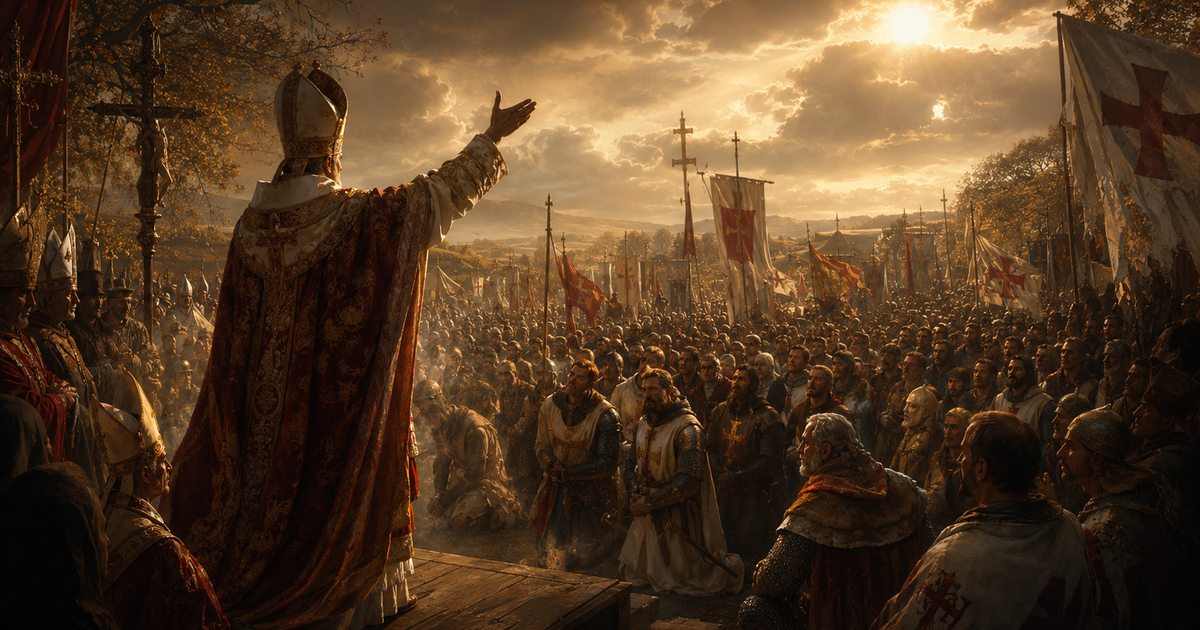
To understand it, we must go back to the year 1095. That year, at the ecumenical Council of Clermont—a great gathering of priests, cardinals and bishops—Pope Urban II delivered one of the most influential speeches in European history. He called upon every Christian knight in Europe to take up arms, march to the Middle East and free Jerusalem and the Holy Places of Christianity from the suffocating Muslim domination; for at that moment the Holy Land was in Islamic hands, and they, as you can well imagine, were not exactly tender with the Christians still living there. In exchange, that crafty pope promised them the total forgiveness of all their crimes and sins on earth and, up in heaven, assured them a privileged seat at the right hand of our Lord Jesus Christ. The response to his call was an immense, continent-wide clamour that crystallised under a motto that would go down in history: «Deus lo Vult—God wills it!».
But the pope himself was, at that very moment, caught completely off guard… For the pontiff had been thinking more of sending an orderly military expedition of knights and nobles, organised and commanded by the cream of the European aristocracy. That would be, ideally, the «official» First Crusade that would set out later, a year on, in 1096. What nobody expected was that, within a few weeks—long before the nobles, the knights and the professional soldiers were ready—something quite different would set off towards Jerusalem, far more popular and infinitely more chaotic: «the Crusade of the Poor». And the man responsible for it was precisely our Peter the Hermit.
The hypnotic power of a humble man
Peter the Hermit was a preaching monk from northern France, hugely popular during the Middle Ages, for he had been born in 1050 in Amiens, a beautiful city some 120 kilometres north of Paris, in what is today the department of the Somme, a French region once known as Picardy. The chronicles describe him as a man of ascetic, striking appearance—gaunt and deep-eyed—always dressed with extreme humility to stay true to his vow of poverty. He moved from village to village on a very old donkey that, for more than a decade, had been his faithful travelling companion. But our Peter had one colossal gift: his mystical, explosive oratory, for he spoke to the common folk with a passion and an eloquence that magnetised and electrified the crowds.
While the nobles organised themselves at their leisure, Peter tirelessly roamed villages and towns preaching the crusade to the common people: peasants, artisans, the poor, serfs of the glebe (peasant slaves bound for life to a plot of land), women, the elderly, children. People with no military training, no decent weapons, no money and no provisions. And he set them ablaze with his words. Wherever he passed, entire multitudes dropped everything and joined him to march on Jerusalem. The chronicle tells us that the common people already venerated him as a saint—so much so that they would pluck the hairs from his donkey to keep as relics. Imagine the level of fervour and mysticism that little man was able to generate.
The People's Crusade: a disaster foretold
And so was born what is known as the People's Crusade, or Crusade of the Poor: an immense, disorganised mass of many thousands of people who, under the leadership of Peter the Hermit and a knight from Boissy-Sans-Avoir named Gauthier—also known as Walter Sans-Avoir, or Walter the Penniless—set off along the roads towards the East in the spring of 1096, many months ahead of the various professional armies gathered by the leading European nobles.
And it was, let us say it plainly, a catastrophe from start to finish. That throng, with neither discipline nor supplies, left a trail of trouble, conflict and death in its wake across Eastern Europe: violence and plunder to feed itself, clashes with the local populations and, in one of the most shameful episodes, the terrible massacres of Jewish communities, with between 12,000 and 15,000 Jews of all ages murdered in several cities along the Rhine, in Prague and in Hungary, perpetrated by stray bands of German crusaders—what a coincidence—loosely associated with, though not an official part of, this movement led by the Hermit. In other words, the mission of Peter and his followers was to reach and liberate Jerusalem, not to slaughter poor Jews right across the middle of Europe. Be that as it may, it was a rather sinister and tragic beginning for an enterprise that presented itself as sacred and blessed by Almighty God.
The end in Asia Minor

Against all odds, a good part of that human mass managed to make its way down through all of Eastern Europe and reach the gates of Constantinople. The Byzantine emperor Alexios I Komnenos—who was expecting the arrival of thousands of disciplined, professional knights and soldiers promised by the pope to fight the invading Muslim Turks—found himself instead with that tide of famished, troublesome and militarily inexperienced poor Europeans, and at first had no idea what to do with them. To get them off his hands and spare his city greater evils, on 6 August 1096, following the advice of his Grand Primicerius—general Tatikios, a kind of trusted private counsellor—he had them hurried across to the other side of the Bosphorus strait, into Asia Minor, right in the middle of a war zone held by the merciless Seljuk Turks of Sultan Kilij Arslan (pronounced «Kilish», and meaning, literally, «the Lion's Sword»).
And there, with Peter absent at the crucial moment (he had gone back to Constantinople to beg for help), the disorganised, undisciplined mass pushed into enemy territory in search of plunder. The Seljuk Turks, expert warriors, ambushed them and annihilated them almost completely in a terrible slaughter. Tens of thousands of those poor, deluded souls died without so much as a glimpse of Jerusalem. The People's Crusade had ended in absolute disaster.
The survivor who did see Jerusalem
And here comes the final twist, the thing that makes Peter such a novelistic character. Because he survived. When, months later, the great army of the «official» First Crusade finally arrived—the one made up of well-armed nobles and knights—Peter the Hermit joined it, now in a far more modest and secondary role. And, with that expedition, the old preacher accompanied the march across Asia Minor. But before Jerusalem, the hell of Antioch still awaited him.
Antioch: when even the prophet faltered
For the brutal, interminable siege of Antioch (1097-1098) was a hell of hunger, cold, disease and despair that dragged on month after month without a single glimmer of hope. The crusader army was bleeding out, and desertions became an unstoppable haemorrhage: soldiers fleeing by night, by the dozen, by the hundred, risking the gallows just to escape that trap. And here comes one of the most human—and least known—episodes of our character. Because, dear readers, in the small hours of 7 January 1098, Peter the Hermit himself—the man who had lit the fuse of the whole madness, a personal friend of Pope Urban II—cracked. And fled. He deserted the camp in secret, in the company of a Frankish noble, William of Melun, nicknamed «the Carpenter», no less than a cousin of the King of France. But the two fugitives did not get far: the relentless Tancred of Hauteville, who had a natural gift for hunting men down, caught up with them a few kilometres from the port of Saint Simeon, just as they were looking for a ship to carry them home. «God has abandoned us, Tancred—face it!», Peter shouted in his defence. It didn't wash. They were dragged back to camp amid shame and general scandal. William the Carpenter was beaten to a pulp by Prince Bohemond of Taranto and humiliated until he was rechristened «William the Coward». Peter, by contrast, was let off with a simple penance by his old friend, the papal legate Adhemar of Le Puy. Well, you know how it goes: with enemies the law is enforced to the letter, and with friends it is interpreted with mercy.
The betrayal that nearly cancelled everything
And as if Peter's own desertion weren't enough, in those very same days came the gravest episode of the entire campaign—one that very nearly cancelled the whole crusade long before it ever reached Jerusalem. Another of the great lords, Count Stephen of Blois—who, it must be said, was only there because his wife Adela had practically shoved him into enlisting—also deserted the siege. But Stephen did something infinitely worse than merely fleeing. On his flight towards the coast, together with another deserter, William of Grandmesnil, he ran headlong into the imperial army of the Byzantine emperor Alexios I Komnenos, who was marching precisely to relieve the crusaders besieged at Antioch. And Stephen—a great friend and admirer of the emperor, convinced that the city had already fallen and that all his former comrades were dead—rode all the way to Philomelion to persuade Alexios to turn back. He succeeded. On 16 June 1098, the emperor ordered the retreat and abandoned the crusaders to their fate. That relief army, longed for like rain in a drought, would never arrive. The news fell like a bomb on Antioch: the crusaders, starving and trapped, felt themselves abandoned once and for all by God and by men. There was probably no bad faith in those two cowards—they sincerely believed all was lost—but their monumental «betrayal» not only left eighty thousand Christians stranded at the worst possible moment; it would later serve Bohemond of Taranto as the perfect alibi to keep Antioch for himself and never return it to the Byzantine Empire, exactly as he had sworn to do. History, more often than not, is written with such squalid deeds.
The most absurd embassy in history
And it was precisely in that climate of utter desperation—abandoned by the emperor and with the colossal army of the Turkish emir of Mosul, Kerbogha—two hundred thousand men—already at the gates, that Peter still had one ace up his sleeve to redeem himself, and what an ace. The crusaders, against all logic, decided to attempt a desperate negotiation. And whom did they choose as ambassador for the most dangerous mission imaginable? Why, the small, filthy, ragged friar on the donkey—precisely so that he might cleanse his tarnished name. And so Peter the Hermit, accompanied by an interpreter named Herluin and brandishing an enormous white flag, presented himself in the emir's sumptuous tent—silk cushions, Persian carpets from Tabriz and, in the middle of June at forty degrees, a jug of water with ice cubes, don't ask me how. And there, before Kerbogha and all his generals, who eyed him with undisguised disgust, the humble monk delivered—with an almost British phlegm and a touch of mockery—the most brazen ultimatum in all of military history: he demanded that Kerbogha surrender. That the Muslim army of two hundred thousand men lay down its arms and withdraw «to save its life». Picture the scene: the besieged side, starving and terrified, demanding the unconditional surrender of the victorious side. Kerbogha nearly choked on his tea with laughter and pointed out to him, amused, the thousands of chains and shackles he had had brought from Baghdad to enslave them all. But Peter, without batting an eyelid, doubled down: he announced, in all seriousness, that the Christians had found a magical, miraculous object, buried for a thousand years, that would make them invincible: the Holy Lance of Christ. The Turkish laughter then became thunderous. The negotiation, as was to be expected, ended in absolute failure, with Kerbogha swearing he would behead Peter with his own hands. And yet, the very next day—28 June 1098—the crusaders, fanaticised precisely by their blind faith in that Lance, sallied out of Antioch and, against all odds, defeated Kerbogha's immense army. History, sometimes, writes the most improbable scripts of all.
In other words: the man who had lit the fuse of that whole movement, whose first attempt had ended in massacre, lived long enough to see fulfilled—at least in part—the dream he had preached. He was able to enter the Holy City for which so many of his followers had died. Afterwards he returned to Europe, founded a monastery and died, now an old man, in relative peace.
The figure of Peter the Hermit sums up like no other the double face of the crusades: sincere fervour and bloody disaster, the faith that moves mountains and the fanaticism that lays waste, the purest idealism and the most absurd tragedy. A little man on a donkey who, with nothing but his words, changed the course of history. For better and for worse.
If this character has fascinated you, you will find his story, and that of the whole First Crusade, in full detail in my book The Crusade of Peter the Hermit, the first volume of the saga of the Eight Crusades. History as you were never told it.